
New Jersey Uses the Superior Court
One naming point clears up a lot of confusion. New Jersey's trial court of general jurisdiction is the Superior Court, not a district court. People who search for a Morris County district court are using the wrong term. The Superior Court hears the cases without the narrow dollar limits of Municipal Court, and it is where most major Morris County matters are decided.
The Superior Court is a statewide court organized into vicinages. Each vicinage runs the trial divisions for its area. Morris County's Superior Court business is centered at the courthouse in Morristown, the county seat.
The Morris/Sussex Vicinage
Morris County belongs to Vicinage 10, which it shares with Sussex County. An Assignment Judge and trial court administrators oversee the calendars, the divisions, and court services across the vicinage. Sussex County keeps its own courthouse functions, but the vicinage administration links the two counties under one structure.
This vicinage model matters for records. A Morris County case is filed and heard in the county, but it is part of a statewide judiciary that publishes case access through state portals rather than a county docket site. The court records page explains those portals.
Superior Court of New Jersey
Morris County Courthouse
56 Washington Street
Morristown, NJ 07960
Vicinage 10 (Morris/Sussex)
Superior Court Divisions in Morris County
The Superior Court is split into divisions, and each one handles a different family of cases. Knowing the division tells you which records office and which portal to use.
| Division | What It Handles |
|---|---|
| Civil Division | Civil lawsuits, special civil, small claims, landlord-tenant, foreclosure, contract, and tort |
| Criminal Division | Indictable offenses, pleas, trials, sentencing, and probation violations |
| Family Division | Divorce, custody, support, domestic violence, juvenile, and adoption; many confidential |
| Chancery / General Equity | Injunctions, foreclosures, complex equity, probate disputes, guardianship disputes |
Criminal detail sits on the arrest records page, family matters on the marriage and divorce records page, and equity probate disputes on the Surrogate's Court page.
Superior Court Versus Municipal Court and Surrogate
Three offices cover most Morris County matters, and they do not overlap much. A quick comparison shows which one fits a given case.
| Court | Handles | Examples |
|---|---|---|
| Superior Court | Major civil, criminal, family, equity | Lawsuits, indictable crimes, divorce |
| Municipal Court | Local limited matters | Traffic tickets, ordinances, disorderly persons |
| Surrogate | Uncontested probate | Wills, estates, guardianship filings |
Traffic and local cases run through Municipal Court, as covered on the traffic court records page. Uncontested probate starts with the Surrogate.
The Tax Court and Property Appeals
New Jersey also has a statewide Tax Court with specialized jurisdiction. It hears local property-tax appeals and state tax disputes. Morris County taxpayers may file Tax Court cases, which matters in a county with high-value residential and commercial property.
The Tax Court is separate from the Superior Court trial divisions, though appeals from it also go to the Appellate Division. Its information and filing resources are on the official page at njcourts.gov.
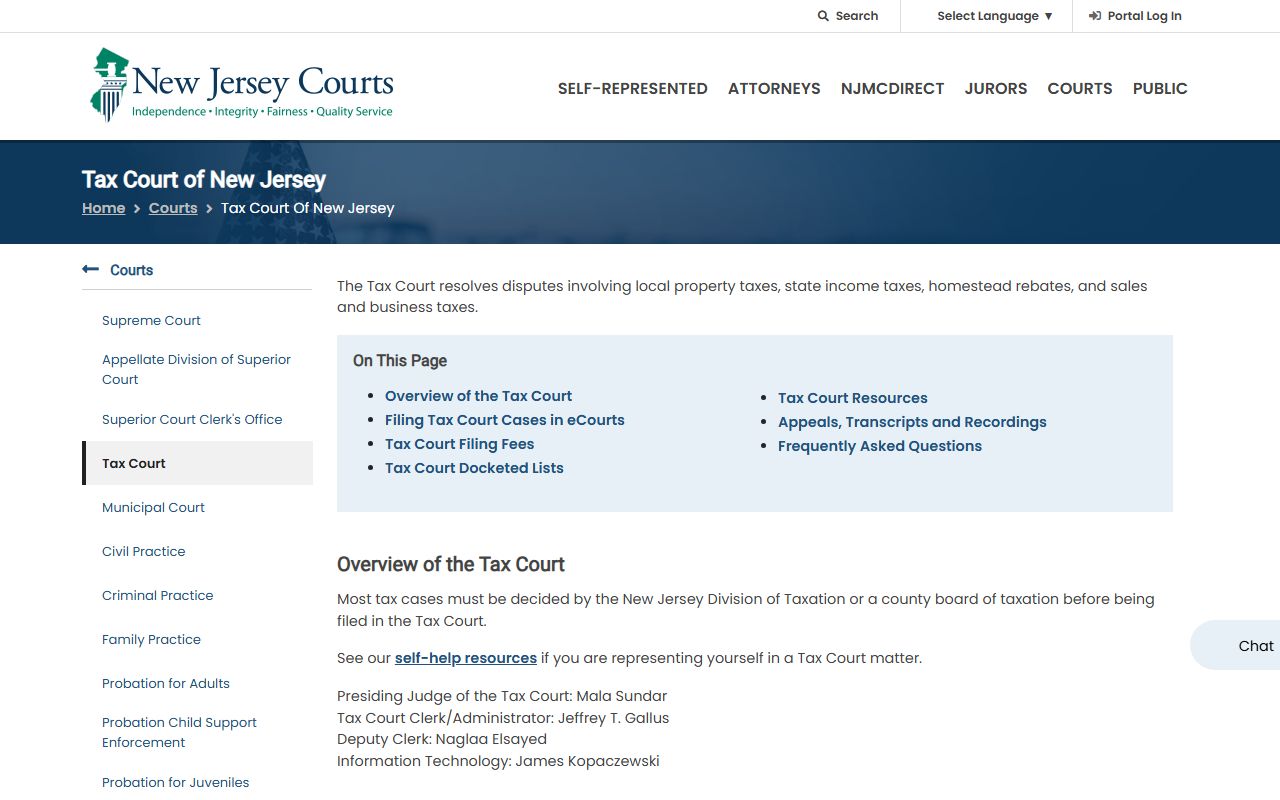
A property-tax appeal is a Tax Court matter, not a County Clerk or Surrogate function.
How a Case Moves Through the System
Cases follow a ladder from the trial level up through appeals. For most Morris County matters, the path looks like this:
Case flow: Municipal Court › Superior Court › Appellate Division › New Jersey Supreme Court
A Municipal Court conviction is first reviewed in Superior Court through a trial on the record, not a brand-new witness trial. Appeals from Superior Court trial divisions and the Tax Court go to the Appellate Division. Final state review rests with the New Jersey Supreme Court. Federal claims arising in Morris County go to the U.S. District Court for the District of New Jersey instead of the county courthouse.
Appeals: Appellate Division and Supreme Court
The Appellate Division is the intermediate appeals court. It reviews orders from the Superior Court trial divisions, the Tax Court, and state agencies. It does not retry the facts; it reviews the record and the law. Most appeals in Morris County cases stop here.
The New Jersey Supreme Court is the highest state court. It takes a limited set of cases and sets the court rules that govern access, including the public-access rule on the court records page. It also handles attorney discipline and statewide judiciary administration. Together, these two courts complete the state appellate path above the Morris County trial divisions.
The Morristown Courthouse
The Superior Court sits in a historic courthouse campus in downtown Morristown, near Court Street, Schuyler Place, Washington Street, and the Morristown Green. Courtrooms, jury functions, security screening, and clerk windows are clustered close together, and nearby county buildings hold the Surrogate, County Clerk, Prosecutor, and Sheriff's functions.
Visitors pass through security screening at entry. Expect magnetometers, bag screening, and limits on weapons and recording devices. Phones may be allowed in many areas, but photography and recording inside court-controlled space are governed by court rules and a judge's orders. Parking is downtown through the Morristown Parking Authority, and NJ Transit rail serves Morristown Station a short walk away. Directions and parking detail sit on the home page.
Federal Court for Morris County Cases
Not every case belongs in the Superior Court. Federal civil-rights suits, federal criminal prosecutions, and federal constitutional claims arising in Morris County go to the U.S. District Court for the District of New Jersey, not the county courthouse. Bankruptcy goes to the U.S. Bankruptcy Court for the district.
These are federal records, searched through PACER rather than the state portals. The district court's official site sits at njd.uscourts.gov.
So a federal matter connected to Morris County is not a Superior Court record at all.
Searching Superior Court Records
Superior Court records are searched through the state portals, not a county system. The NJ Courts Find a Case hub routes you to Civil Case Public Access, Criminal Cases Public Access, and Judgment Search. You pick the division that matches your case, accept the disclaimer, and search by docket number or party name.
Family Division records carry the heaviest limits, so a divorce or custody file may show only limited public information. Many docket entries are open, but sealed, juvenile, and confidential family material is withheld under court rule. Certified copies come from the Clerk of the Superior Court, and full search steps are on the court records and court dockets pages.