
How to Find Morris County Marriage and Divorce Records
Start by sorting the request. A marriage license or a certified marriage certificate is a vital record. A divorce judgment is a court record. They live in different systems, and mixing them up is the most common mistake.
Use this routing to reach the right office:
- Marriage license application goes to the municipal registrar where an applicant lives.
- Certified marriage copies come from the registrar or the New Jersey Office of Vital Statistics.
- Divorce filing goes to the Superior Court Family Division for Morris County.
- Certified divorce decrees are requested from the court, not the county clerk.
The County Clerk officiates some marriage ceremonies and may help with certain older county marriage records, but New Jersey marriage licensing is mainly a municipal and state function. See the Morris County Clerk page for that office's role.
Marriage Licenses in New Jersey
New Jersey issues marriage licenses through local registrars. The license usually comes from the municipality where one of the applicants lives. If both applicants live outside New Jersey, they apply in the municipality where the ceremony will take place. There is a state waiting period after applying, unless a court waives it.
The state vital-records office sets the framework for licenses and certificates. Its page, at nj.gov/health/vital, explains the registrar system and how vital records work statewide.
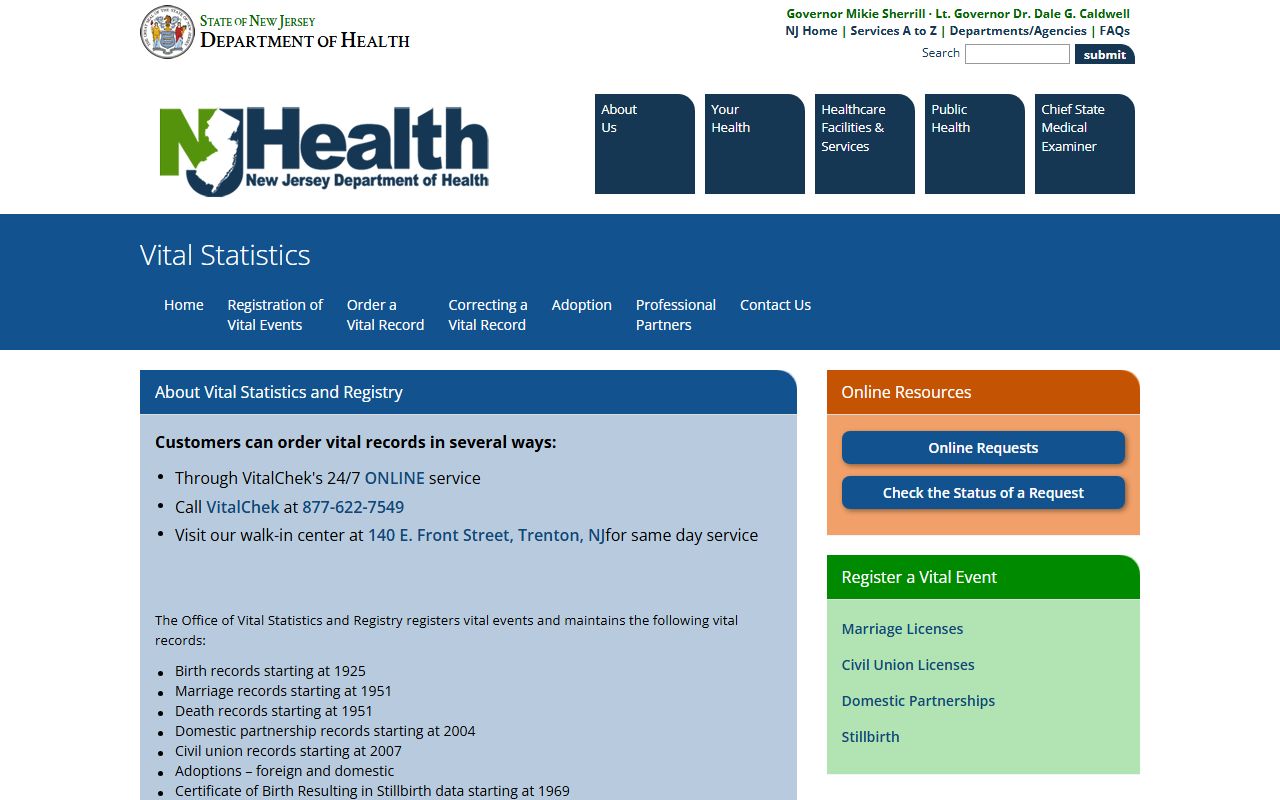
Because licensing is local, the registrar in the applicant's town is the right first contact, not the courthouse.
How to Apply for a Marriage License
The application process is straightforward, but each step has a requirement. Plan for identification, residency proof, and the waiting period.
- Contact the registrar for the municipality where an applicant lives, or where the ceremony will occur if both are nonresidents.
- Bring required identification and proof of residency as the registrar directs.
- Provide the intended officiant and ceremony-location information if required.
- Pay the state and local marriage-license fee.
- Observe New Jersey's waiting period unless a court waives it.
- Have an authorized officiant perform the ceremony and return the completed license for registration.
- Request certified copies later from the registrar or the state vital-records office.
The license is not the keepsake certificate. The certified copy used for legal proof comes after the ceremony is registered.
Marriage License Application Fields
Applicants complete a standard set of fields at the registrar. Some information is confidential and never appears in a public record.
| Field Label | Type | Required | Notes / Format |
|---|---|---|---|
| Applicant names | Text | Yes | Legal names of both applicants |
| Residence address | Text | Yes | Determines the registrar's jurisdiction |
| Date and place of birth | Date / Text | Yes | Identity and vital-statistics data |
| Prior marriage status | Text | Yes | Divorce, death, or dissolution details if any |
| Social Security number | Text | If applicable | Confidential; not public |
| Ceremony date and place | Date / Text | Yes | Municipality and venue |
| Oath / signature | Signature | Yes | Applicants certify the information |
Witness and officiant details are recorded at application or ceremony, depending on the local process.
Certified Marriage Records
For a certified marriage certificate, contact the municipal registrar that issued the license or the New Jersey Office of Vital Statistics. A certified copy is the official version used for name changes, benefits, and legal proof. The ordering process and fees are explained on the state's vital-record ordering page.
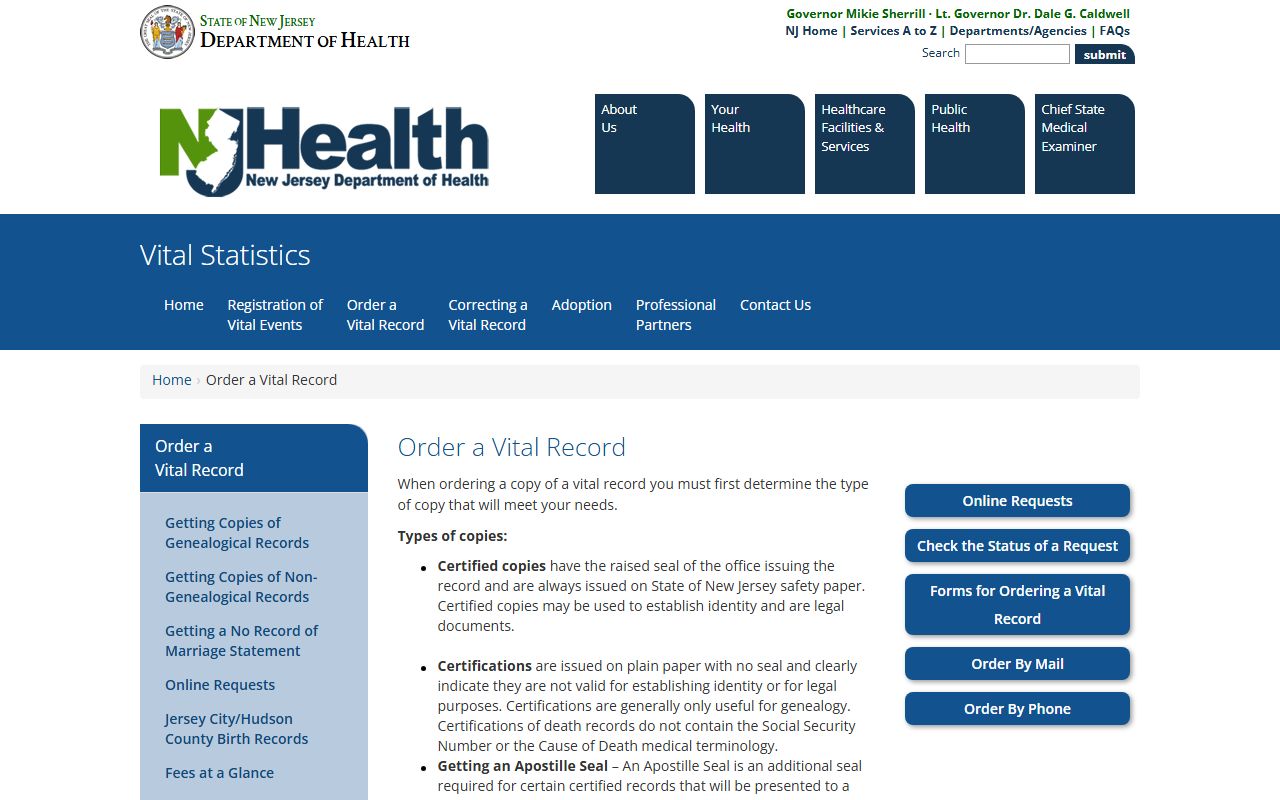
The Morris County Clerk may help with certain historical county marriage records, but current certified copies are vital-record work, as covered on the Morris County Clerk page.
Divorce Records and the Family Division
Divorce is different from marriage. A divorce case is filed in the Superior Court Family Division, and for Morris County residents it is generally filed in Morris County when venue rules are met. The file is a court record, so it follows court access rules rather than vital-record rules. Final judgments of divorce can usually be requested by the parties or authorized persons.
Public access is limited under New Jersey Court Rule 1:38 and family confidentiality rules. Sensitive financial information, child-related pleadings, domestic violence material, and sealed documents may be restricted. The court records page explains the broader access framework.
Child custody and support records sit inside the family case and carry the heaviest protections. Custody, parenting-time, and support orders involve children, so the public view is narrow even when a divorce docket exists. Domestic violence restraining orders are handled with special confidentiality for victim safety. A party to the case, or an authorized person, has more access than a member of the public, and a certified copy still requires the court's process.
How to File for Divorce in Morris County
New Jersey publishes statewide self-help divorce forms through NJ Courts. The exact packet depends on whether there are children and whether the case is contested. A typical path looks like this:
- Confirm New Jersey residency and venue requirements.
- Choose the correct packet: with or without children, contested or uncontested, and a fee waiver if needed.
- Prepare the complaint and required certifications, including the confidential litigant information statement.
- File with the Superior Court Family Division and pay the filing fee or apply for a waiver.
- Serve the other spouse under court rules and file proof of service.
- Move through case management, custody and support issues, settlement, or trial to a final judgment.
The NJ Courts divorce self-help page has the current forms and instructions.
Fees and Fee Waivers
Fees apply at several steps, and they are set by the office that handles the record. Confirm the current amount before you pay, since schedules change. Fee waivers may be available to qualifying divorce litigants.
| Item | Where the Fee Is Set |
|---|---|
| Marriage license | State and local registrar schedule |
| Certified marriage copy | Registrar or NJ Department of Health schedule |
| Divorce filing | NJ Courts fee schedule; waivers for qualifying litigants |
| Certified divorce copy | Court records and copy schedule |
Fee-waiver forms are on the NJ Courts fee-waiver page. A waiver covers certain court filing costs, but not every outside cost such as service or transcripts.
Annulment, Common-Law, and Same-Sex Marriage
A few special rules round out the picture. An annulment declares a marriage legally void or voidable on specific grounds, while a divorce dissolves a valid marriage. New Jersey does not create new common-law marriages, though it may recognize a valid common-law marriage from a state that allows them. Same-sex couples may marry in New Jersey, and those records follow the same vital-record framework.
Any of these can raise legal questions that court staff cannot answer. For procedure, the NJ Courts self-help center is the official starting point, and the FAQ page answers common record questions.