
How to Search Morris County Probate Records
Uncontested probate records are kept by the Morris County Surrogate. You search or request by the decedent's name, the date of death, an estate or docket number, and the fiduciary's name if you know it. Some records can be reached online, while others need Surrogate staff or an in-person visit, especially older files.
The Surrogate's Office page is the official starting point. It links probate, estate, and guardianship resources. The page, at morriscountynj.gov, also explains forms and appointment procedures.
For a contested matter, the related case may sit in Superior Court Chancery rather than the Surrogate, as explained below.
The Morris County Surrogate's Office
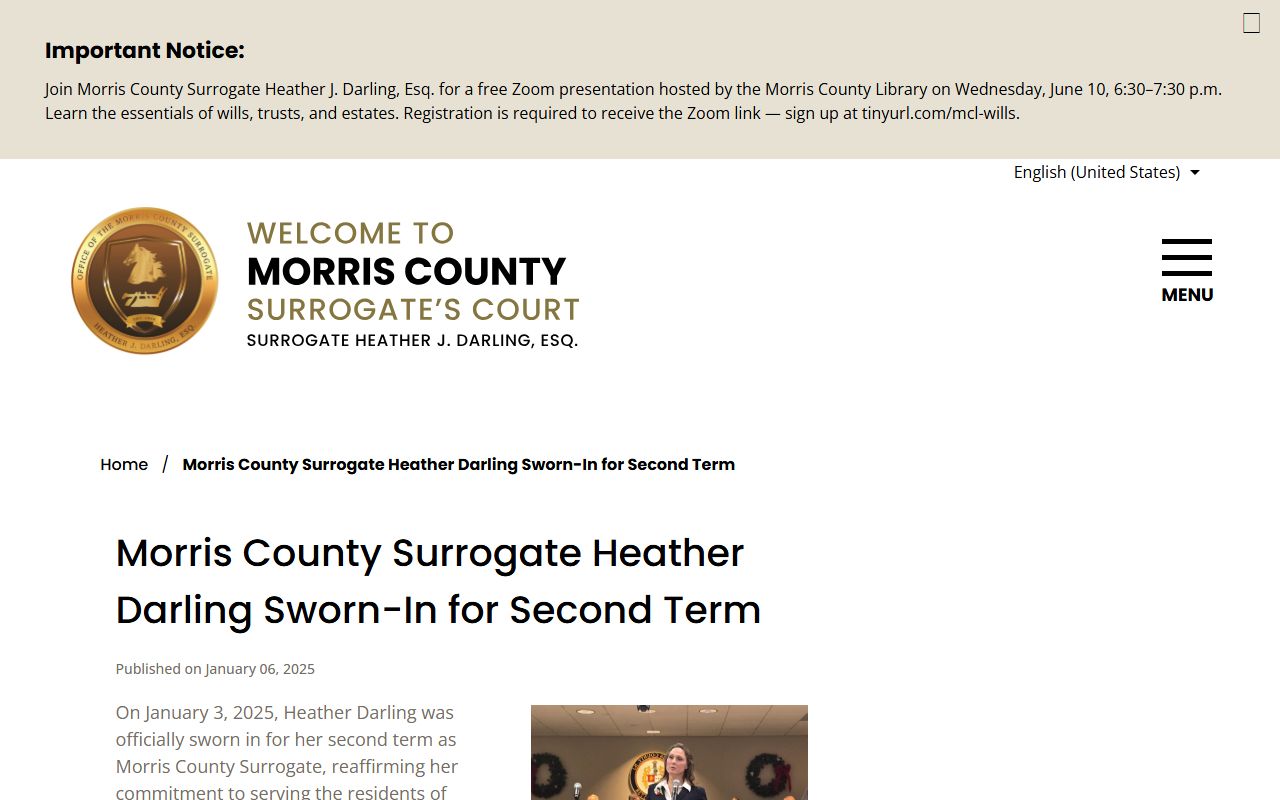
The Morris County Surrogate is an elected official whose full title is Judge of the Surrogate Court. Heather J. Darling, Esq., serves as the Morris County Surrogate. She was first elected in 2019 and was sworn in for a second term on January 3, 2025. Each Surrogate term runs five years. The office is more than a records counter, because the Surrogate has judicial duties in admitting wills and appointing fiduciaries.
Morris County Surrogate's Court
Morris County government complex
Morristown, NJ
Heather J. Darling, Esq., Surrogate
Judge of the Surrogate Court
The Surrogate biography page describes Darling's background in family, wills, trusts, and estates. It sits at morriscountynj.gov.
The office has modernized service in recent years. The official second-term release describes electronic filing, credit-card payment, 24-hour appointment scheduling, and education sessions about wills and estate planning. That announcement sits at morriscountynj.gov.
So a Morris County estate can often be started with online filing and a scheduled appointment rather than a paper-only counter visit.
How Probate Works in Morris County
Probate is the court-supervised process of settling an estate. For a Morris County resident who died with a valid will and no dispute, the named executor starts the process at the Surrogate. When there is no will, an eligible next of kin applies for administration under intestacy rules.
- Confirm the decedent was domiciled in Morris County.
- Locate the original will and the death certificate.
- Contact the Surrogate's Office for the appointment, procedure, and required forms.
- The executor applies to probate the will, or an heir applies for administration if there is no will.
- The applicant signs qualification papers and pays the filing and certificate fees.
- The Surrogate issues letters testamentary or letters of administration.
- The fiduciary gathers assets, notifies heirs and creditors, handles taxes, and distributes the estate.
If a dispute arises along the way, the matter may require Superior Court filings instead of the Surrogate.
What Morris County Probate Records Contain
A probate file builds up as an estate is settled. Many records are public, but guardianship details, medical information, and minors' data may be restricted. A typical file can include:
- The original will, death certificate, and application for probate.
- Executor qualification, or an administration application when there is no will.
- Renunciations, surety bond if required, and Surrogate certificates.
- Inventory, accountings, and refunding bonds or releases.
- Guardianship reports and court orders in contested matters.
Restricted fields such as Social Security numbers, financial account details, and minor data are protected.
Probate Search Fields
Whether you search online or request through staff, the same identifiers narrow a probate file. The decedent's name is the primary key.
| Field Label | Type | Required | Notes / Format |
|---|---|---|---|
| Decedent Name | Text | Primary | Last name first is recommended |
| Docket / Estate Number | Text | No | Direct lookup if known |
| Date of Death | Date | No | Narrows the search |
| Filing Date | Date | No | Surrogate filing or probate date |
| Fiduciary Name | Text | No | Executor, administrator, or guardian |
| Record Type | Dropdown | No | Will, administration, guardianship, certificate |
Older estate records may need an archive search. The New Jersey State Archives county records guide helps with historical probate research.
Wills, Administrations, and Small Estates
The path depends on whether there is a will. With a valid will, the named executor probates it and receives letters testamentary. Without a will, an eligible relative seeks letters of administration under intestacy priority. New Jersey also has simplified small-estate procedures based on the estate's value and the surviving family relationship.
The exact small-estate threshold and who may use it depend on whether there is a surviving spouse, domestic partner, or civil union partner, and on the value of assets. Use the Surrogate or NJ Courts official forms for the current threshold rather than an old figure.
Guardianship and the Minors' Trust Fund
The Surrogate's work goes beyond decedents' estates. The office handles guardianship-related filings, and adult guardianship of an incapacitated person is a Superior Court Chancery matter with Surrogate involvement in filing and qualification. Those records can include medical affidavits, judgments, guardian reports, and accountings, and many medical and personal details are confidential.
The Morris County Surrogate also serves as custodian of the Minors' Intermingled Trust Fund, holding funds for county minors. The office has highlighted outreach as well, including a partnership with the Morris County Veterans Services Office described in an official release at morriscountynj.gov.
Contested Probate and Superior Court Chancery
Not every estate is simple. When heirs dispute a will, challenge a fiduciary, contest an accounting, or fight over a guardianship, the matter moves out of the Surrogate's uncontested track. It proceeds in the Superior Court Chancery Division, which handles equity and probate disputes.
So a contested Morris County estate can generate both a Surrogate file and a related Chancery docket. The Superior Court page explains the Chancery role, and the court records page covers how to search the related case.
Probate Fees
The Surrogate charges fees for probate, administration, certificates, and copies. Amounts vary by the number of pages and certificates, so confirm the current schedule with the office before you file.
| Item | Fee / Note |
|---|---|
| Probate of will | Surrogate schedule; varies by pages and certificates |
| Administration | Surrogate schedule |
| Surrogate certificate | Per-certificate fee; confirm current amount |
| Guardianship filing | Surrogate or Chancery schedule |
| Certified copy | Depends on pages and certification |
The office's credit-card payment option, noted in its modernization release, can make paying these fees easier.
Probate Terms Explained
Probate uses words that rarely come up elsewhere. A short glossary clears up most filings:
- Testator
- The person who made the will.
- Executor
- The person named in a will to settle the estate.
- Administrator
- The person appointed to settle an estate with no will.
- Intestate
- Dying without a valid will.
- Guardianship
- Court authority to care for a minor or an incapacitated adult.
- Conservatorship
- Court authority to manage another person's property or finances.